Desktop AI Robot for Developers

Bring AI out of the screen and onto your desk.

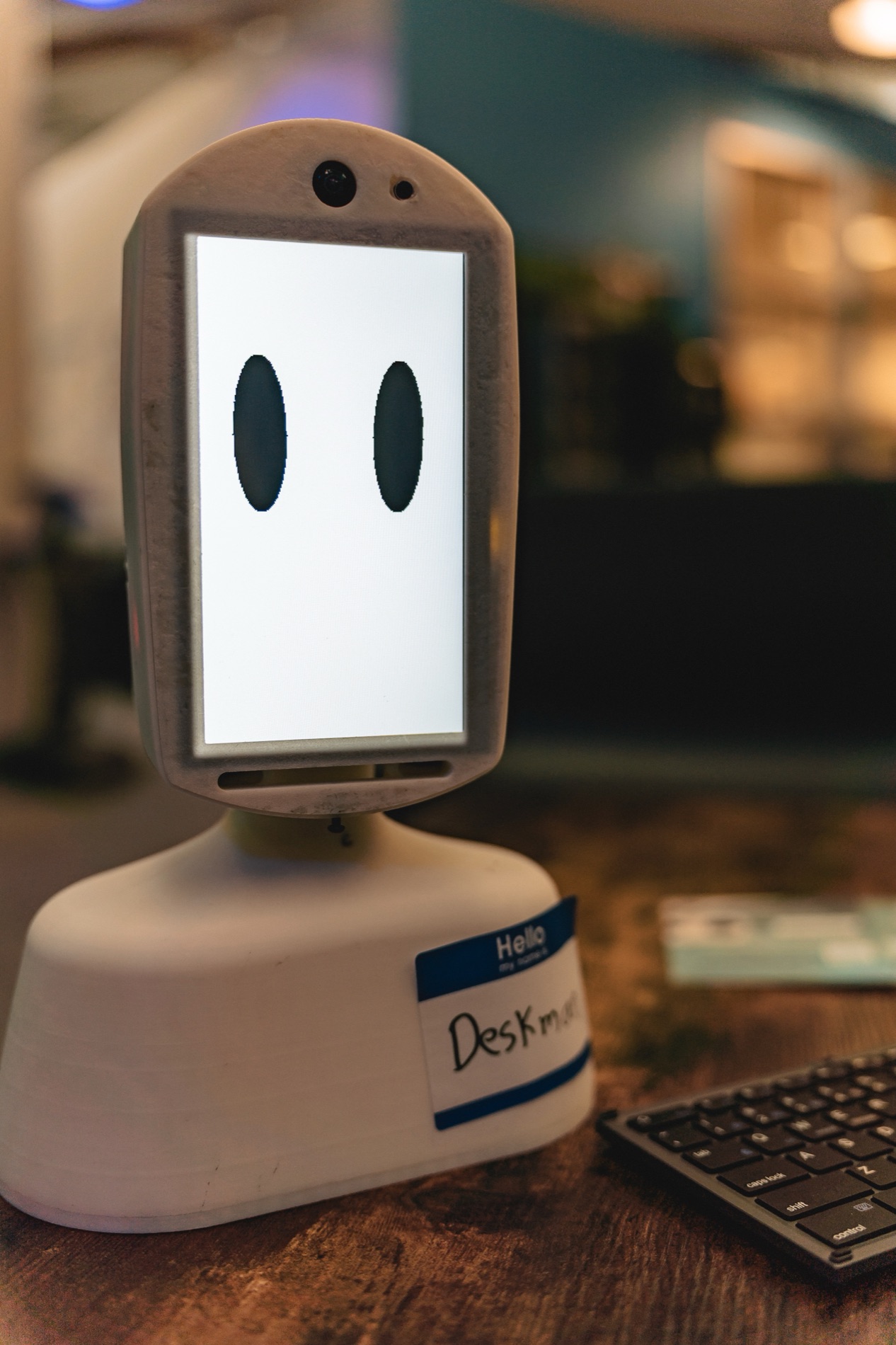
Deskman is a hackable desktop robot for developers, makers, AI researchers, and roboticists — a compact physical AI platform you can talk to, program, and completely rebuild.

Arrives assembled and ready to develop on.

No cloudrequired
No subscriptionrequired
No internetrequired

What can you build?

Just about anything. You get a ready-to-program physical robot instead of a pile of dev boards, servos, cameras, speakers, and cables — log in and start building.

Local voice assistants Robot personalities Vision-language models Local LLMs Computer vision Face & person tracking Human-robot interaction Home automation Embodied AI Telepresence AI agents with a body Your own experiments

Local AI

The whole pipeline runs on the robot.

Powered by an NVIDIA Jetson Orin Nano 8GB with CUDA acceleration and a 256GB SSD. The full conversational loop runs locally — no API connection required. Swap in any model you like.

Microphone Speech-to-Text LLM Text-to-Speech Speaker

As open-source AI improves, Deskman improves with it.

A robot you can hack

Deskman isn't a sealed consumer assistant — it's designed to be modified. The software runs on Linux and Python, and the hardware is accessible, so you can change how it behaves, replace models, modify the motion system, add sensors, or use it as the starting point for your own robot. The body is 3D printed, so it's easy to remix mechanically too.

$ ssh deskman@deskman.local
deskman@deskman.local:~$ cd speak
deskman@deskman.local:~/speak$ ./talk.py
Loading whisper...
Loaded on GPU in 5.7 sec
Loading kokoro...
Loaded on GPU in 10.0 sec, voice bm_fable
Loading text model server...
Started in 7.5 sec on GPU. Model: gemma-4-e2b
Starting text model inference...
Started in 4.5 sec
Follow-up open 20s
After Hi, talk for 20s without "robot". Then say "robot" to talk again. "robot quit" or CTRL-C to stop.

Movement

Three actuated degrees of freedom on Waveshare bus servos. The head moves in pitch and yaw to turn toward people and react during conversation. A third actuator moves the hat, covering and revealing the camera and display. Drive it all from your own Python.
Vision

An Arducam camera gives Deskman sight — face tracking (out of the box), person and object detection, and visual interaction. The software pairs vision with the actuated head, so Deskman physically orients toward the people it sees.

See Deskman in action

A couple of clips of Deskman doing its thing.

What's inside

NVIDIA Jetson Orin Nano 8GB
256GB M.2 SSD
7" IPS touchscreen
Arducam camera
3× ST3215 bus servos
Servo controller
Speaker + audio amplifier
USB audio interface
Microphone
5,800mAh Li-ion battery + charger
3D-printed body, head & hat
Foldable keyboard + trackpad

Software

Open. Yours to change.

Runs on Linux and Python, with CUDA accelerating speech-to-text, the LLM, and text-to-speech. Compatible with modern open-source STT, TTS, computer vision, and local language models — swap components as new models arrive. You're not locked into a proprietary AI service.

Use the models you want. Modify the code. Build something weird.

Why a physical robot?

Talking to AI on a screen is useful. Talking to a robot sitting on your desk feels different. Deskman gives AI a physical presence — it can turn toward you, make eye contact, speak naturally, and serve as a platform for experimenting with embodied AI and human-robot interaction.

MakersHackersStudents ResearchersAI developers Robotics developersFuture-builders

Put a robot on your desk.
SSH in. Start hacking.

Deskman arrives assembled and ready to develop on.